


When a client is in an uncertain situation, there is rarely any need for big words. What matters is very concrete:
financial security, safety, and control.
Money matters because it creates room to act, peace of mind, and the ability to make good decisions. At the same time, I know that financial value is rarely created by being tough. It comes from being precise, well-prepared, and human, and from making it easy for the other party to land a solution together with you
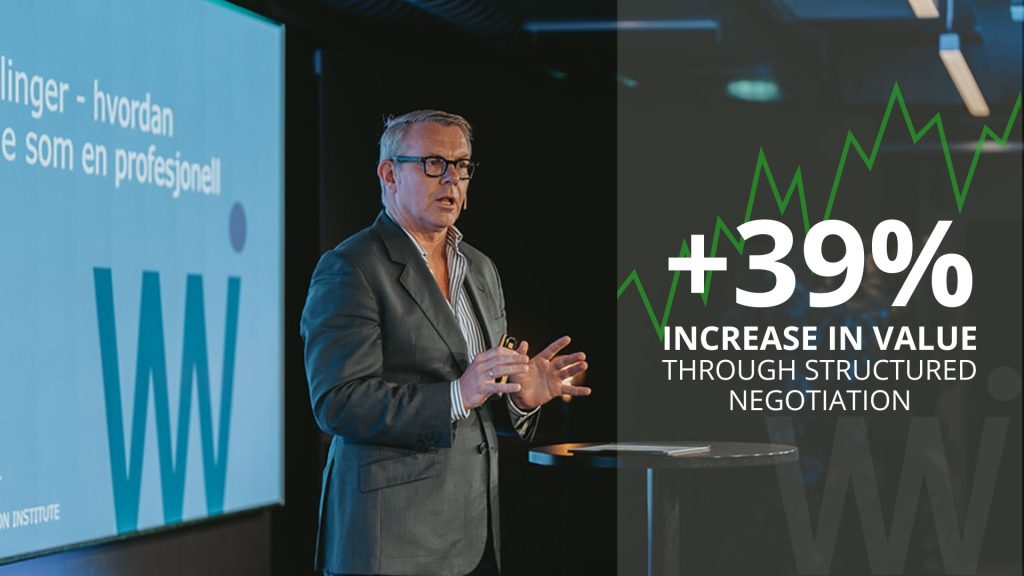
I recently supported a client in a termination case. The client achieved a +39% improvement in economic value from the initial offer to the final agreement.
For the client, this was not a “nice number,” but increased security, more room to act, and better control in a demanding period.
For me as an advisor, the value is twofold:
- I help the client strengthen their position, so the financial outcome improves, and
- I guide the process, so the agreement becomes robust enough to work in practice, without unnecessary friction.
Advisory and sparring that creates value: security, direction, and implementation
Sparring is not about “winning a discussion.” It is about building strength in the client – so the client can negotiate with calm and direction. When I work one-to-one, we do it in a confidential setting where the goal is to create three types of value:
- Clarity: What matters most, what is secondary, and what is the right sequence?
- Risk reduction: What is the real risk, and how do we reduce it through clear wording and documentation?
- Implementation: How do we create an agreement the other party actually wants – and can – carry out?
This is the core of how I work with advisory and sparring: We clarify the goal, explore drivers and solutions, build strategy, and prepare the client’s communication so that it creates value – not noise. (wni.as)
Before we negotiate the solution, we clarify whether there is a foundation to land an agreement
This is one of the points I am very clear about when I coach and teach: Before you negotiate a solution, you must examine whether there is actually a strong enough foundation to land an agreement. If the foundation is not there, you must strengthen your alternative.
In practice, this means we work on two tracks at the same time. We build a “landing track” that makes it possible to sign with confidence. And we strengthen an “alternative track”, so the client is not locked by fear. When the client knows,
“I can land—but I am not trapped,”
the dynamic changes. It becomes easier to stay calm, ask the right questions, and prioritize what creates the most value.
How I guide the client to better value
The Power of Nice is not a “soft” philosophy. It is a practical method for creating value when the risk is high. The essence is:
- to make the client strong and confident,
- to see the value of relationship and process,
- and to work systematically—not summarizing, not being hard for the sake of it.
In this case, the method was applied very concretely through three P’s:
Preparation: We made the client robust. A clear goal, clear priorities, and a clear plan for what had to be in place to sign with confidence. We removed the temptation to open new side negotiations that steal energy and create more uncertainty.
Probing: We asked questions that created information and space, not defensiveness. The goal was to understand what the other party could actually move on, what was locked, and where it was possible to create value through alternative wording or practical solutions. Good exploration builds trust and makes it possible to ask tough questions later – without the process derailing.
Proposals: We made it easy to say yes. Not with vague demands, but with concrete proposals for wording, sequence, and process. The proposals were framed so the other party could accept without loss of face, and without internal problems such as “why are we giving this?”
This is where much of the value lies: When the client follows this structure, you often achieve both a better financial outcome and a process that becomes more stable, more predictable, and significantly easier to bring to the finish line.
That is value creation in the result and value creation in the implementation.
More value creation, less threat, more collaboration
In demanding processes, a lot happens below the surface. People move toward what feels safe and rewarding, and away from what feels threatening. When the threat level goes up, people become more defensive and less solution-oriented. When safety and reward are felt more strongly, collaboration becomes easier.
I use practical tools in the process to reduce the experience of threats and increase reward in the dialogue. In this case, that meant, among other things:
- We worked so the other party could land the agreement without losing face. The language was clean and respectful, and the focus was on solution and implementation – not blame.
- We created clarity through a few clear points and a concrete path to signature. This reduces stress and improves decision-making.
- We offered choices and realistic alternatives rather than ultimatums. When the other party experiences control, the willingness to find a solution increases.
- We kept the dialogue warm and professional so that the collaborative climate remained intact.
- We tied proposals to reasonableness and consequences, so it felt legitimate to adjust the agreement.
The point is not to “psychologize.” The point is to increase value by making the process safer and more workable. When the threat level goes down and the willingness to collaborate goes up, it often becomes easier to find good solutions – and financial value can increase without escalation.
Give and take with value in focus
Every agreement involves give and take. The key is to give what matters little to us – and take what matters a lot. You do not achieve that with gut feeling alone. You achieve it through solid preparation and a good understanding of what actually creates value for both sides.
In this case, we prioritized hard. We put energy into what moved the most value for the client – and we framed things so the other party could join the solution. When you do this well, it becomes easy to say yes – and expensive to say no.
The value of a truly good agreement
An agreement is only truly good when it can be implemented in practice. Many underestimate this: You can get “good financial terms” on paper, but if wording and process create doubt, friction, or unpredictability, the real-life value becomes lower.
That is why I always work with value on two levels:
- value in the outcome (financial terms and risk reduction), and
- value in the implementation (clarity, collaboration, and process control).
In this case, that produced a concrete financial value improvement of +39%, while the process became clean and workable – without unnecessary escalation.
This is the combination clients are willing to pay for:
more value – and a safe path to get there.
And then it is genuinely nice to receive a message like this from the client after signing:
“Fantastic, Roar! You deliver an impressive amount in a short time! Thank you, thank you for clarifying, sparring, and for fast and clear responses! I’m impressed by the experience, the abilities, and the tool you’ve created here!”
